

Avison Young

Author: Prestige PR Data: 2026-09-22

Why do retail parks attract investors?

Extract from the investment report “Retail parks uncovered” by Avison Young and partners: CMS, Newgate Investment, PROH

Authors

Paulina Brzeszkiewicz-Kuczyńska – Research and Data Manager, Avison Young

Bogda Korolczuk – Managing Director, Member of the Board, Polish Council of Shopping Places

Krystian Modrzejewski – Chief Investment Office, Newgate Investment

Retail parks – historically

The oldest properties of this type were developed in late 90’s along with the political change in Poland. Pioneers were building on the edges of major metropolitan cities and established the first retail destinations, supplemented by other retail formats.

“We observed three decades of varied development dynamics. In 2019 the Polish market accommodated 1.5 million sqm in retail parks exceeding 5,000 sqm of GLA. During and after COVID-19 pandemics outbreak in 2020 retail parks strengthened their position, as they were not subject to serious restriction neither closing, due to their architectural concept without common areas. Local and convenience shopping trends ballooned. Boosted by changing retail habits of the customers and growth of investors’ confidence in this safe format, real retail park development boom has begun.” – Paulina Brzeszkiewicz-Kuczyńska, Research and Data Manager, Avison Young

In 2020-2025 the supply grew by impressive 2.2 million sqm of GLA and further 220,000 sqm in H1 2026 with H2 pipeline estimated at 480,000 sqm. Moreover, according to investors’ announcements, similar supply of new retail space in retail park format is planned to be completed in 2027.

Diversity that reshapes the rules of the game

New retail supply in Poland is now dominated by retail parks – in the first half of 2026 they accounted for 92% of all openings.

At the same time, shopping centres are undergoing deep transformation: modernisations, repositioning, extensions and functional expansion. The average Polish consumer visits them 44 times a year, increasingly not just for shopping. Centres are becoming a “third place”: a space for meeting, services, dining, healthcare, education and local activities.

– Demographic structure is changing in parallel. Population ageing and the expected depopulation of many regions – up to 1.4 million people in the coming years – will significantly reshape customer profiles. Another factor influencing today’s retail landscape is the strong differentiation between generations: Baby Boomers, Gen X and Y, and the emerging Gen Z and Alpha. This means retail properties must serve several radically different consumption models at once. For some, medical, rehabilitation and accessibility services will be key; for others, entertainment, dining, education or seamless integration of offline and online experiences – Bogda Korolczuk, Managing Director, Member of the Board, Polish Council of Shopping Places.

Retail parks – nowadays

Currently, total supply of retail parks is estimated at 3,8 million sqm GLA which reflects 25% share in total modern retail space in Poland. We have 355 operating retail parks and ca. 680 thousand sqm of retail park format is underway.

As of August 2026, the 10 most active retail park and convenience retail developers accounted for nearly 60% of the newly built supply. Saller led the market with an 11% share of the total stock under construction, followed by Redkom Development and BIG Poland with an 8% and 7% share, respectively.

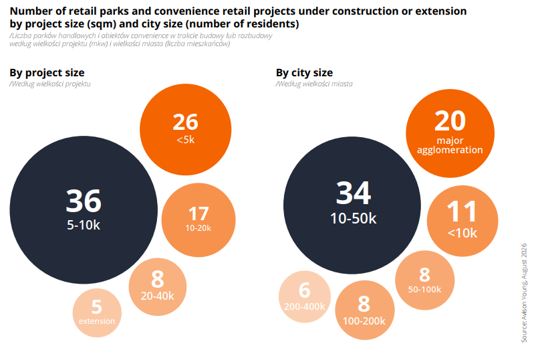
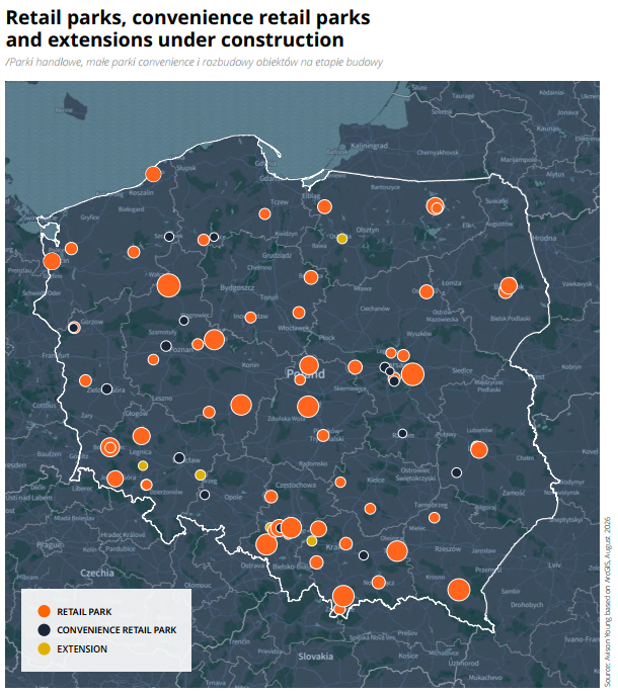
The total volume of retail park and convenience retail park space currently under construction is estimated at record-high 746,000 sqm within 88 developments.

The ownership structure of retail parks under development remains highly fragmented, with around 50 active developers currently advancing projects at the construction stage.

A significant portion – 44% – of the new supply is being developed in towns below 50,000 residents, while 25% is located in Poland’s eight largest metropolitan areas. This trend reflects filling the modern retail white spots in smaller cities, as well as supplementing existing offer in major cities, according to 15-minute city concept. Notably, 26 of 88 projects underway exceed 10,000 sqm in size.

Dynamic retail park growth is reflected in the new supply completed since 2020. In the retail park format it amounted to 2.2 million sqm, while in shopping centres it slightly exceeded 500,000 sqm, excluding asset closures.

Why invest in retail parks?

Retail parks are currently among the most stable segments of the retail real estate market in Europe. Their attractiveness is based on convenient locations, easy access and an offer tailored to consumers’ everyday needs. At the same time, the sector has undergone a significant transformation in recent years. Modern retail parks increasingly go beyond a traditional offer based solely on discount stores and convenience retailers, attracting new tenants and retail formats that were previously absent from local markets.

This trend is also visible across the Newgate Investment portfolio. Centrum Rowerowe has joined the tenant line-up at Comfy Park

Bydgoszcz, while RR Moto is expanding its offer at Park Wysockiego. Brands of this kind enhance the tenant mix, extend the assets’ catchment areas and attract customers seeking a more specialised offer.

From an investment perspective, the segment is characterised by stable occupancy levels, predictable cash flows and strong resilience to changing market conditions. The gradual but consistent yield compression observed over the past decade also confirms the market’s increasing maturity and reflects growing investor interest in this asset class.

“We believe that retail parks located in medium-sized cities, particularly those with populations above 50,000, offer attractive investment opportunities. These markets are often characterised by strong local purchasing power, limited supply of modern retail space and a loyal customer base. In many cases, well-located assets can continue to deliver above-average performance through thoughtful repositioning and quality upgrades, without the need for extensive redevelopment.” – Krystian Modrzejewski, Chief Investment Office, Newgate Investment.

Newgate Investment perceives retail parks as assets offering significant potential for long-term value growth. Active asset

management, modernisation, ESG initiatives and operational optimisation remain key elements of our value creation and portfolio development strategy.

“For Newgate Investment, Poland is not only a growth market for new retail park developments, but also a market where value can be created effectively through the development and transformation of existing assets. We believe that the next stage of the sector’s growth will be driven not only by new supply, but also by the modernisation, repositioning and sustainable transformation of operating retail parks located in strong regional catchment areas. It is precisely in this segment that we see some of the greatest investment potential for the coming years.” – Krystian Modrzejewski, Chief Investment Office, Newgate Investment.